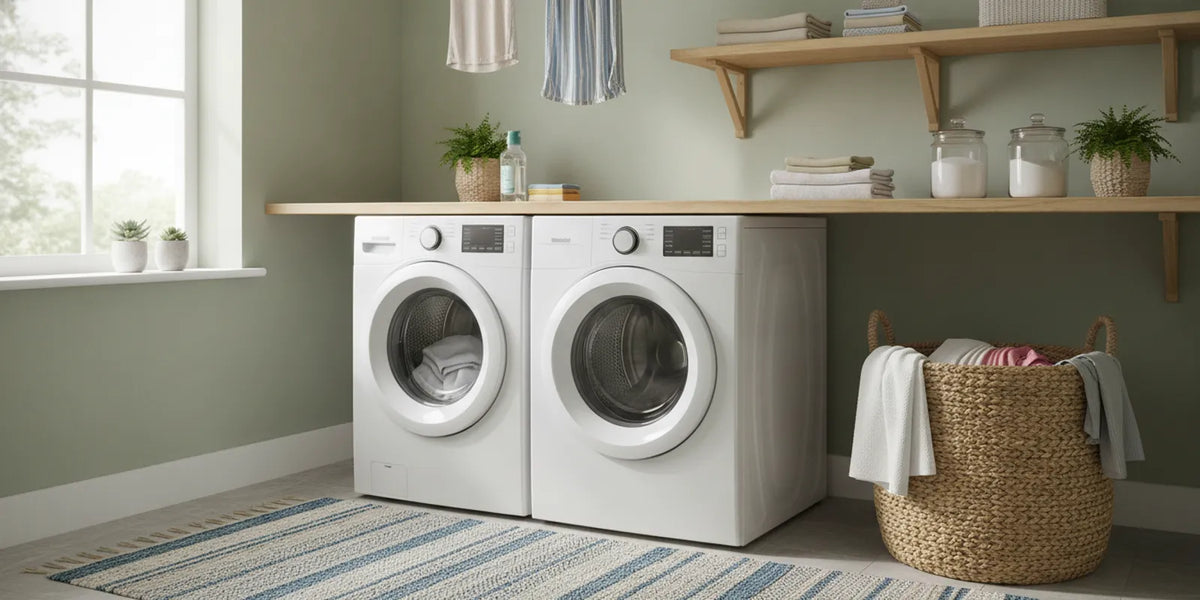
Washable Rug for Laundry Room: Practical Placement and Care
A washable rug for laundry room floors can make a hardworking space feel more comfortable and give everyday lint or drips a place to land. The best location depends on where you stand most: at the sink, in front of the washer and dryer, or along the path between them. Treat the rug as a useful layer for daily living, not a promise that every spill will be stopped or every floor protected.
Ask a question about rug sizing
Map your laundry routine before choosing a spot
Start with the tasks you do in the room, not with the empty patch of floor that looks easiest to cover. A laundry room may be a simple closet with a stacked washer and dryer, or a larger workspace with a sink, folding counter, hampers, and cabinets. Each layout creates a different standing zone. Follow your routine once and notice where you pause, turn, sort, load, and transfer clothes. Those places are better candidates than a spot that only looks balanced from the doorway.
Think through one ordinary load from start to finish. You might carry a basket in, sort clothes beside a counter, load the washer, move wet laundry to the dryer, and fold items on a nearby surface. A rug only needs to serve the part of that route where you spend time standing. If it covers the full route, it may become an obstacle when you pull a hamper or carry a basket. In a narrow room, a single rug at the main work station can be simpler than several pieces scattered along the floor.
Then check what moves. Open the washer door, dryer door, cabinet fronts, and drawers all the way. If there is a utility sink cabinet, open that too. Make sure the rug will not sit under a moving door, intrude into the machine opening, or block access you need for routine cleaning and maintenance. Check thresholds and the route in and out of the room, especially if a door swings inward. The rug should lie flat with its edges outside the path of doors and feet.
Finally, pay attention to where water or lint tends to appear. A sink area may see small splashes; a front-loading washer can leave you standing in front of the drum; a dryer may be where lint collects. That observation helps choose a location, but it does not mean the rug should be placed where a leak or constant water exposure is likely. Clean up moisture promptly and address the source of a persistent leak rather than relying on a rug.
Place a rug by the sink for a defined work zone
If you use a laundry sink for hand-washing, rinsing, or filling a container, position a compact rug where your feet naturally stand. Center it on that working area rather than trying to cover the whole cabinet run. Leave room for cabinet doors and drawers to open, and check whether the rug would be caught by the sink cabinet toe kick or extend into a busy walkway. A clear edge around the rug makes it easier to step on and off without catching a corner.
Before settling on the placement, stand at the sink as you normally would. Reach for the faucet, turn to set something down, and imagine moving a laundry basket past you. If the rug forces you to twist around an edge or makes the path feel cramped, shift it or choose a smaller format. If you have a long cabinet with more than one work point, one rug should not be expected to cover every step while still leaving doors and circulation clear.
A rug near a sink can collect some of the ordinary moisture that lands nearby, but it is not a substitute for wiping up splashes. Blot a spill promptly, then spot-treat it in line with the care directions. Some marks, particularly oil-based stains, can set quickly. If a larger accident calls for more than spot care, follow the washing instructions for the specific rug. Avoid leaving a damp rug on the floor for an extended period; make sure the floor and rug are dry before you put it back.
Color and pattern are practical choices here as well as decorative ones. A pattern may make ordinary lint less conspicuous between cleanings, but it does not keep lint from collecting or remove the need to vacuum or shake the rug as appropriate. A quieter design can help a small room feel less busy, while a more noticeable motif can bring color to plain cabinetry. Choose a look that works with the flooring and nearby rooms, since laundry rooms are often open to a hall or kitchen.
Set up the washer and dryer standing area
In front of front-loading machines, place the rug where you stand to load, unload, and transfer a basket. Keep its nearest edge outside the door swing and check the clearance with both machine doors fully open. You may need to step back to pull clothes from the drum, so judge the available floor with the doors open rather than measuring only the closed-machine footprint. Keep access to any drain, vent, or service area clear, and follow appliance instructions for the space around the machines.
Think about the direction a laundry basket travels. If you lift a basket from the washer and turn toward the dryer, a rug that ends directly under your pivot point may shift or bunch as you step. A flat, well-positioned rug should not interfere with that movement. Try the route with an empty basket before deciding that the rug covers enough floor. If the basket repeatedly pushes the edge, move the rug out of the turning line or consider a different size.
Top-loading machines call for a different fit check. Open the lid completely and reach into the drum as you would when removing clothes. The rug should not obstruct a stable stance or sit where its edge could catch your heel as you step closer. In a tight alcove, take the measurement with the lid open and with any nearby door or cabinet in its normal open position. If you cannot keep a usable standing area and clear movement at the same time, a rug in another laundry-room zone may be the better choice.
Machine vibration is another reason to check the actual layout rather than assume a rug will stay where first placed. The backing is intended for suitable floors, but it is not a universal slip-prevention guarantee, and the traction is not effective over carpet. Start with a clean, dry floor and a clean backing, lay the rug flat, and check its position after normal use. If it shifts, curls, or catches, remove it and reassess the surface and placement instead of continuing to use it in that spot.
Do not position a rug beneath an appliance or use it to conceal a maintenance issue. Keep the area around machines accessible, and do not cover a vent or other required opening. If an appliance leaks, stop and address the leak. A built-in waterproof lining within the rug's nonslip backing can make a liquid spill or pet accident less likely to soak through to hard-surface flooring, but it does not guarantee protection in every situation or replace prompt cleanup.
Use a runner only when the walkway has room
A runner can make sense in a long, narrow laundry room where you regularly walk between the entrance, sink, and machines. The 2.5x7 runner is a format to consider for an elongated working area, but those dimensions do not automatically fit every room. Measure the open path and compare it with the actual rug measurements on the product page. Leave an uncovered margin at thresholds, cabinet bases, and appliance fronts so the runner does not press against doors or force people to walk on a raised edge.
For a practical paper test, mark the proposed runner's length and width on the floor with painter's tape or another removable marker that will not damage the surface. Walk the route with a laundry basket. Open the door, cabinets, washer, and dryer. Look at the fit from the doorway and from inside the room. This small trial helps reveal whether the runner narrows the walkway, catches on a door, or places its end where you pivot. Check that any tape used for measuring is removed before the rug goes down.
In a compact laundry nook, a 3x5 accent rug may work better as a defined standing area than a runner. It can be positioned by the machines or the sink, depending on the layout. The right choice is not simply the largest rug that fits on paper. Ask whether the rug covers the useful standing zone without spreading into areas that need to remain open. For rooms with multiple work points, moving a single rug as needed may also be easier to manage than placing several pieces.
Use the rug size guide as one planning reference, then verify the dimensions on the live product listing. Measure the floor, not just the space between the machines: wall trim, cabinet overhangs, door arcs, and irregular corners can change the amount of usable floor. If the rug needs to fit beside a hamper, include the hamper's footprint too. A measurement that leaves only a narrow strip for walking is a sign to try a smaller format or a different placement.
Compare the formats against the job they need to do
It helps to compare rug shapes by the work they support rather than by room label alone. The table below is a planning tool, not a promise that a given size fits every laundry room. Check the exact dimensions and the current product details before choosing. You can also browse the washable rug collection to compare formats and designs.
| Format to consider | Best fit to test | Measure and check |
|---|---|---|
| Compact accent rug, such as 3x5 | One main standing spot by a sink or machines | Door swings, cabinet access, open floor around the work zone |
| Runner, such as 2.5x7 | A longer route through a narrow laundry space | Clearance at thresholds, path width, turns with a basket |
| No rug in the laundry room | A floor plan with little clearance or a spot that stays wet | Whether a different nearby room is a more suitable placement |
Use the first option when most of your time is spent in one place. It is often easier to keep clear of doors, and it may be simpler to pick up and manage during cleaning. A compact rug can leave parts of the room uncovered; that is not a flaw if it serves the main standing area. Avoid sizing up simply to cover every visible patch of floor. Keeping movement and appliance access clear matters more than making the floor look uniformly covered.
Consider the runner when you have a longer route and enough width to walk comfortably beside its edges. A runner should not become a narrow obstacle course between the machines and the wall. If one side is squeezed against cabinetry and the other side is a frequent walking path, test whether the rug's position remains natural. The taped outline test is especially useful here, because the shape's length can look deceptively manageable until a door is open or a basket is in hand.
Choosing no rug in a particular spot is a sensible outcome if the floor is crowded, the rug would sit under a door, or that area is persistently damp. A rug belongs where it can lie flat and be cared for. You can still use one in a different part of the room, or decide that the available floor does not support a rug safely. Good room planning includes knowing when not to cover a surface.
Match the rug to the laundry room you actually have
In a narrow closet laundry, begin with the door and appliance opening. A rug that works in front of the machines may need to stay short enough that the closet door can close and the appliance doors can open. Measure from the closed door to the nearest machine front, then recheck with the appliance open. If the room is so small that a rug overlaps the door swing or creates a raised threshold, skip it rather than force a fit.
For a laundry room with a sink and a counter, decide whether the sink or the machines are the more frequent standing station. One rug centered at the sink may be more useful if you hand-wash or pretreat clothes there. A rug at the machines may make more sense if you mainly load and transfer laundry. If both areas are used, measure the space between them and see whether one format can serve a continuous route without crowding the entrance. It may be more practical to cover only the station where you spend the most time.
In a shared mudroom and laundry space, consider how outdoor shoes, coats, pet bowls, or other household traffic affect the placement. A rug should not interfere with an entry door, a shoe bench, or the route used to carry laundry. Avoid treating a laundry rug as a barrier against tracked-in dirt or water. It may collect some everyday debris, but regular cleaning and prompt attention to moisture still matter. Keep any pet feeding area distinct if bowls make the floor frequently wet.
For a laundry room that opens to a hallway or kitchen, look at the sightline as well as the measurements. Choose a pattern and palette that feel connected to the adjoining space, while keeping the rug's primary job in mind. You might compare designs in the kitchen rug collection if the laundry area is open to a kitchen, or look at entry and doorway rug styles for a connected threshold. Check that the selected rug's listed size is appropriate for the laundry floor rather than choosing by collection name alone.
Choose a pattern and profile for a working space
A laundry room is often a small room with several hard surfaces, appliances, and stored supplies. A rug can introduce color and soften the visual effect, but the design should support the room rather than compete with every other pattern. Look at cabinet color, wall color, flooring, and any curtains or storage bins. If those features are already visually busy, a quieter pattern may feel easier to live with. If the room is mostly plain, a stronger motif can give it character.
Pattern scale matters in a compact area. A large, open motif may read differently when the rug is partly covered by a hamper or machine door. A dense pattern can disguise the appearance of everyday lint better than a solid, very light surface, though it cannot replace regular cleaning. When possible, consider the whole rug design rather than judging from a small screen image. Check product photos and details, and remember that the same pattern can feel different in a narrow runner and a compact accent size.
My Magic Carpet describes its rugs as having a low-pile profile of about one quarter inch. A low profile may be practical in a working area, but it does not remove the need to check clearances. Measure the rug's listed dimensions and consider where edges will sit in relation to doors, machine fronts, and the route you walk. The backing is designed for suitable floor surfaces; it should not be treated as a solution for carpet or as a guarantee that a rug cannot move.
The one-piece rug format can be useful when you prefer not to manage a separate rug pad and cover. The newer construction is described as a built-in waterproof lining within the nonslip backing. That can make a spill or pet accident less likely to soak through to hard-surface flooring, but results depend on the situation, and it is not guaranteed floor protection. Learn more about how the rug construction works, and use the product listing for the specific rug's materials and care information.
Clean promptly and follow the care sequence
For an everyday spot, start by blotting rather than rubbing. Rubbing can spread a mess or work it farther into the surface. Then spot-treat the area according to the rug's care guidance. Attend to marks when you notice them, since some stains, especially oil-based ones, can set quickly. Do not assume that a washable rug can be left soiled until the next full wash or that every mark will come out the same way.
When the rug needs a full wash, the care sequence is straightforward: wash it separately on a cold, delicate cycle with mild detergent. Tumble-dry on low or air-dry. Do not use bleach, high heat, or an iron. Follow the current care directions for the selected rug. Washing separately also gives the rug room to move through the cycle without other laundry mixed in. Do not substitute a harsher cycle or higher heat because a stain is stubborn.
Plan for the rug's size before laundry day. Do not assume that every size fits every home washer; size-specific washer capacity has not been confirmed for all options. Check the dimensions and the product guidance, then compare them with your machine's capacity. If you are unsure whether a rug can be washed in your washer, ask about that specific size before purchasing or washing it. Also consider where you can lay it flat to dry if you choose air-drying, and leave enough room for it to dry fully before returning it to the floor.
Between washes, remove loose lint as appropriate for the product by vacuuming or shaking it out. Keep the backing and floor clean, and check that the rug remains flat when you put it back. If moisture is under the rug, lift it and let the surfaces dry rather than covering a damp floor. These small habits help the room stay presentable and make it easier to spot a spill before it sits. For more product care answers, visit the frequently asked questions.
Make a quick fit check before ordering
Before choosing a design, make a short measurement list. Record the width and length of clear floor, the location of machine doors, cabinet fronts, and the entry door, and the distance to any threshold. Then note the main standing spot and the route you take with a basket. Include any hamper or folding station that regularly occupies the floor. This turns a vague sense of room size into a set of practical checks you can compare against the product listing.
- Check the work zone: identify whether the sink, washer, dryer, or walkway is the priority.
- Check open clearances: open every door or drawer that may cross the rug's footprint.
- Check the walking route: carry a basket through the space and look for turns or edges that could catch.
- Check the surface: use the nonslip backing only on a suitable floor, not carpet, and keep the floor clean and dry.
- Check the care plan: confirm the washing instructions and whether your washer can handle the selected size.
- Check the current listing: verify actual dimensions, materials, and current availability before ordering.
If a measurement is close, use a removable outline on the floor rather than relying on memory. Test the room with appliances and cabinets open, then walk the route several times. That extra check can show whether a corner is too near a doorway or whether the rug leaves an awkward strip where you need to stand. Do not order a size based only on the name of a collection or on a general room-size rule; compare actual dimensions with your own layout.
Also consider where the rug will go on wash day. A small size may be easier for you to lift and manage than a larger one, but washer capacity still depends on the specific rug and machine. Keep space available for drying, and check the product information rather than assuming all patterns share identical options. The assortment and details can change, so make the final decision using the live product page.
If you have a question about a listed size, materials, or care instructions, contact the team before ordering. Review current shipping and return information at checkout as well; policies and eligibility may vary or change, so do not rely on an old summary when making a purchase.
Browse washable rug styles and sizes
Frequently asked questions
Should a laundry room rug go by the sink or the machines?
Put it where you stand most often, as long as it does not interfere with doors, drawers, appliance access, or the walking route. If you use both areas, measure to see whether one rug can serve a shared zone without crowding the room.
Is a runner or a compact accent rug better?
A runner is worth considering for a long, clear walkway, while a compact accent rug may suit one main standing station. Measure the available floor and test the outline with doors open and a laundry basket in hand before choosing.
Does a washable rug keep every spill off the floor?
No. The built-in waterproof lining within the nonslip backing can make a liquid spill or pet accident less likely to soak through to hard-surface flooring, but it does not guarantee protection. Blot and spot-treat promptly, and follow the washing directions for larger messes.
Can every rug size go in a home washer?
Do not assume every size fits every washer. Check the guidance for the specific rug and compare it with your machine's capacity; size-specific capacity guidance is not confirmed for all sizes.
Can I use the nonslip backing over carpet?
No. The backing's traction is not effective over carpet. Use it on a suitable floor, lay the rug flat, and check that it stays in place during normal use.
A well-placed laundry room rug can add color and comfort where you work most, while prompt cleanup and simple care help keep everyday messes manageable.